As industrial manufacturing undergoes intelligent upgrades, traditional EOT cranes—reliant on simple electrical controls and resistor-based speed regulation—struggle to meet modern factory requirements for high-precision, high-safety, and high-efficiency lifting operations. In accordance with the latest requirements of ISO 12480-1:2024 (“Cranes — Safe use — General”), mandatory standards now include features such as remote operation, operational condition monitoring, and safety planning, thereby raising the industry’s compliance threshold. Modern intelligent control systems—featuring PLC-based control, variable-frequency stepless speed regulation, and multimodal operation—effectively resolve issues such as operational instability, limited control capabilities, and high energy consumption, serving as a core component in the intelligent upgrade of industrial EOT cranes.
Table of Contents
Multi-mode Control for Full Working Conditions
Traditional EOT cranes rely on limited control modes and lack adaptability, making them ill-suited for complex and dynamic workshop environments. Modern control systems integrate three freely switchable modes—cab control, wired pendant control, and wireless remote control—to comprehensively cover a wide range of operational scenarios. Cab control offers a wide field of view and stable operation for high-precision assembly tasks involving heavy loads and long spans; wired pendant control provides a reliable, low-maintenance solution for routine, light-duty lifting; and wireless remote control enables safe, contactless operation from a distance in hazardous environments—such as those with high temperatures, heavy dust, or dense equipment layouts—thereby eliminating the risks associated with close-proximity operation. This design, featuring flexible mode switching, significantly enhances both equipment utilization and operational versatility.
Variable-frequency Speed Regulation for Higher Stability & Precision
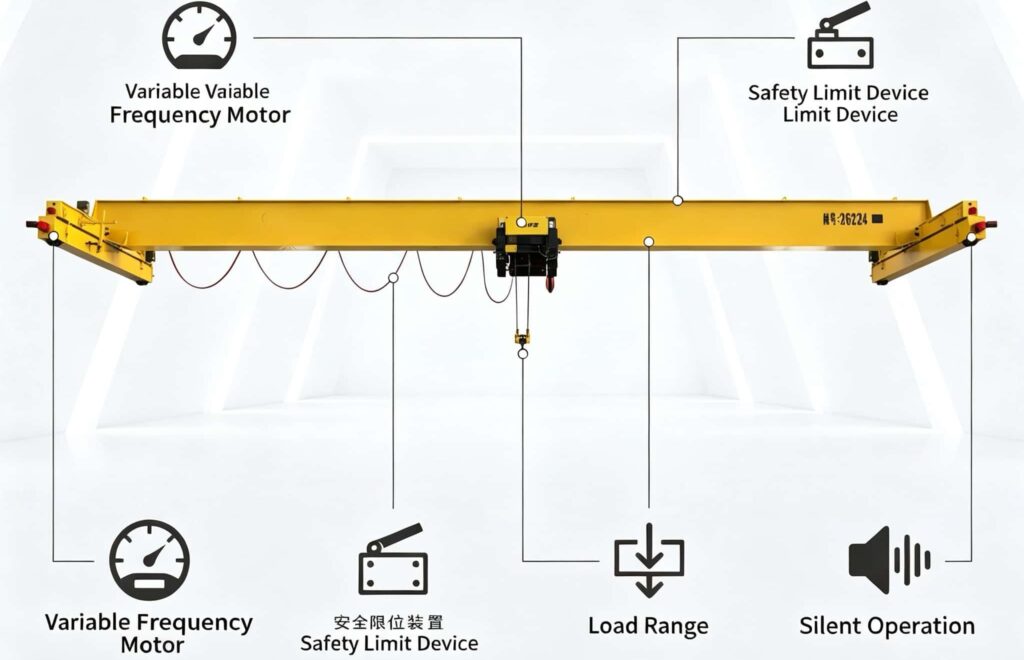
Traditional resistance-controlled cranes suffer from significant impact during startup and shutdown, noticeable load swaying, and poor positioning accuracy, often leading to workpiece collisions and assembly errors that compromise production precision. Modern EOT cranes utilize PLC-based variable frequency drive (VFD) technology to ensure smooth, controlled operation across all phases—including startup, shutdown, acceleration, deceleration, and coasting—thereby fundamentally suppressing load sway and structural vibration. Equipped with micro-speed fine-tuning and precise point-to-point positioning capabilities, these cranes enable high-precision tasks such as mold mating, precision component installation, and large-scale equipment alignment; this effectively reduces workpiece damage and rework costs while significantly enhancing lifting stability and operational accuracy.
Intelligent Protection for Reliable Safety
In accordance with ISO safety standards for lifting equipment, this modern control system establishes an active, comprehensive, and intelligent safety protection framework, overcoming the limitations of traditional passive protection methods. The system integrates multiple safety mechanisms—including overload protection, travel limits, emergency braking, undervoltage protection, and anti-collision systems—to provide 24-hour real-time monitoring of equipment load, travel, and circuit status. Upon detecting anomalies such as overloading, over-travel, or operational errors, the system immediately cuts power, engages the brakes, and triggers an alarm to prevent accidents. Additionally, the system features fault self-diagnosis and operational data logging capabilities, facilitating preventive maintenance, minimizing unexpected downtime, and ensuring continuous, stable production operations.
Energy-saving & Low-maintenance for Smart Factories
Traditional electrical control systems suffer from high energy consumption, cluttered wiring, and complex maintenance, making them unsuitable for the high-efficiency, low-carbon production requirements of smart factories. Modern variable-frequency control systems adaptively adjust operating power based on real-time loads, minimizing wasted energy and delivering significant long-term savings. Featuring a modular, integrated design with organized wiring and clearly identifiable fault points, these systems drastically reduce maintenance and operational costs. Furthermore, they seamlessly integrate with factory digital management platforms to enable remote monitoring, data visualization, and automated maintenance cycles, perfectly aligning with the trend toward unmanned, digitalized factory operations.
Conclusion
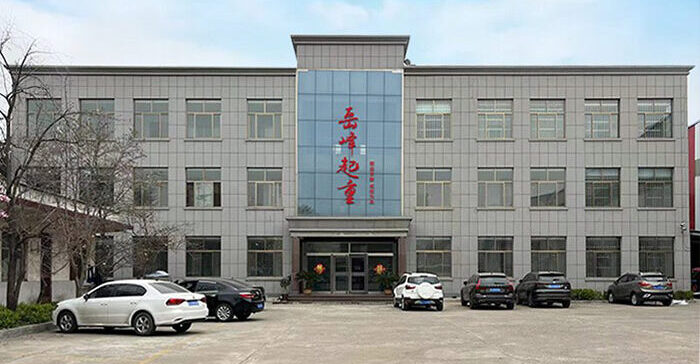
Overall, modern control systems comprehensively upgrade the performance of EOT cranes across four key dimensions—operational flexibility, precision, safety protection, and energy-efficient maintenance—aligning perfectly with the industry trends of standardization, intelligent operation, and enhanced safety. Against the backdrop of evolving equipment standards and rising demands for factory automation, Yuefeng Lifting remains dedicated to the intelligent upgrading of lifting equipment. Leveraging mature variable-frequency control technology, multi-mode operation schemes, and robust safety systems, the company customizes high-performance EOT cranes for diverse industrial applications. These solutions help enterprises improve lifting precision, reduce energy consumption during operation and maintenance, and ensure standardized safety, thereby providing stable and reliable lifting support for intelligent industrial manufacturing.