
When sourcing lifting equipment for factories, steel stockyards, precast concrete plants and machining workshops, three crane types dominate the market: overhead crane (EOT crane), full gantry crane and semi gantry crane. Many purchasing managers and project engineers struggle to decide which model matches their building condition, space layout, working frequency and budget.
There is no one-size-fits-all lifting solution. Each crane design comes with unique strengths and limits. This side-by-side comparison breaks down their structure, pros, cons and ideal use cases to simplify your crane selection.
Table of Contents

1. Overhead Crane (EOT Crane)
An overhead crane, also called EOT crane, mounts on runway beams fixed to the building’s structural columns. It runs on elevated tracks on both sides of the bay and has no supporting legs touching the ground.
Benefits of Overhead Crane
- Fully unobstructed ground: No legs or ground rails to block forklifts, trucks and material flow
- Covers the entire width of the workshop bay for seamless production-line lifting
- Smooth and precise travel performance, great for high-frequency continuous indoor operations
- Mature design with abundant spare parts for easy maintenance
Drawbacks of Overhead Crane
- Strict structural requirement: Your building columns and frame must be engineered to carry crane loads
- Not designed for open outdoor yards
- Expensive modification cost if retrofitting an old workshop without pre-installed runway beams
When to Choose Overhead Crane
Pick the EOT crane if you have a closed, purpose-built workshop with strong support columns and runway beams. It works best when you need lifting coverage across the whole bay and want to keep the floor clear.
2. Full Gantry Crane
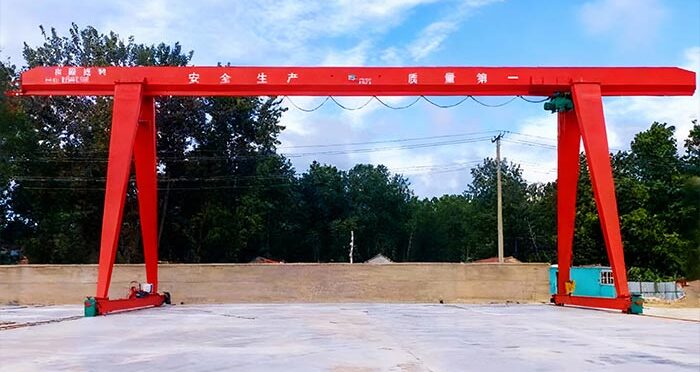
A full gantry crane is self-supported with two rigid legs. Both legs travel along ground-mounted rails. It relies entirely on its own frame instead of your factory building.
Benefits of Full Gantry Crane
- Independent structure, no dependence on building brackets or roof load capacity
- Works reliably indoors and outdoors; the top choice for open-air stockyards
- Flexible rail layout: Rails can be laid on any qualified flat concrete ground
- Wide span options to handle large storage zones and heavy precast components
Drawbacks of Full Gantry Crane
- Requires double-side concrete foundation and rail installation, higher civil engineering investment
- Two support legs and ground rails occupy floor space and may block vehicle passages
- Not ideal if you want to preserve maximum usable area inside a small workshop
When to Choose Full Gantry Crane
Choose the full gantry crane for outdoor yards, precast factories, steel storage lots, or sites where your building cannot bear overhead crane loads.
3. Semi Gantry Crane
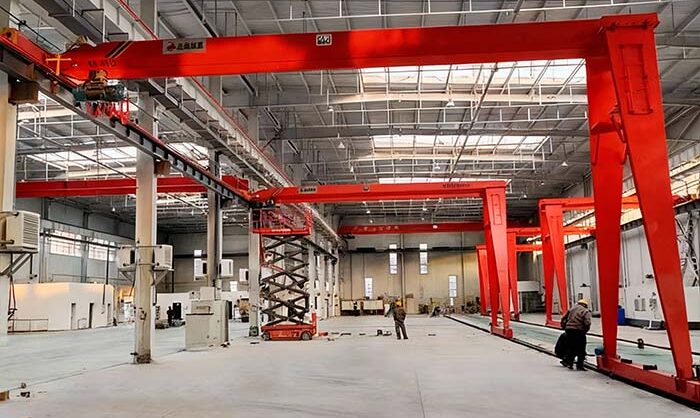
A semi gantry crane (also known as half gantry crane or single leg gantry crane) is a hybrid design. One side uses a steel leg moving on ground rails, while the other side rides on an existing overhead runway beam fixed to walls or factory columns.
Benefits of Semi Gantry Crane
- Lower civil cost: Only one side needs ground foundation and rails, cheaper than full gantry crane
- Perfect for workshop edge zones, filling the lifting blind spot of main overhead cranes
- Ideal for old workshop upgrades; no need to reinforce the entire building frame
- Compact footprint, suitable for feeding machines, mold storage and side unloading platforms
Drawbacks of Semi Gantry Crane
- Only serves partial working zones along the wall, cannot cover the full workshop width
- You must verify the load-bearing capacity of the existing overhead support beam before installation
When to Choose Semi Gantry Crane
Select the semi gantry crane when you only need lifting along one side of the workshop, you have a usable overhead support beam, and you hope to cut foundation construction costs.
4. Quick Comparison Table of the Three Cranes
| Item | Overhead Crane (EOT) | Full Gantry Crane | Semi Gantry Crane |
|---|---|---|---|
| Supporting Method | Elevated runway beams on both sides of building | Two legs on ground rails | One leg on ground rail + one side on building beam |
| Primary Working Place | Indoor enclosed workshop | Open yard / sites without building support | Workshop edge, beside-wall workstation |
| Ground Obstructions | None | Two legs + double rails | Single leg + one rail |
| Civil Work Cost | High (if no pre-built runway) | High (double foundation) | Moderate, lowest of the three |
| Lifting Coverage | Full bay width | Custom wide span | Partial side zone |
| Outdoor Application | Not recommended | Yes | Yes (with rainproof and anti-corrosion design) |
5. Step-by-Step Selection Guide
Follow this simple logic to narrow down your crane type:
- Check your building structure first If your workshop already has qualified runway beams on both sides → overhead crane is your priority. If you operate in an open yard and have no available building support → choose full gantry crane. If only one side has a load-bearing beam and lifting work is only needed near the wall → semi gantry crane is the cost-saving option.
- Confirm your workflow and budget If you only handle materials on the workshop edge and want to reduce foundation spending, the semi gantry crane delivers the best value. It complements the main overhead crane without the high cost of a full gantry unit.
Conclusion
Overhead crane, full gantry crane and semi gantry crane are complementary lifting solutions rather than direct replacements. The best crane depends on your site layout, building capacity, working area and budget.
Send us your site photos, required span, lifting height and tonnage, and our engineering team will evaluate your layout and recommend the most suitable crane model.
Shandong Yuefeng Crane Machinery supplies custom overhead cranes, full gantry cranes and semi gantry cranes for clients across Africa, the Middle East, Southeast Asia and Central Asia.