
If you are renovating an old industrial facility, adding lifting equipment to production workstations along the sides of a building, or seeking a cost-effective alternative to full-gantry or overhead bridge cranes, you will likely encounter the semi-gantry crane. Also known as a “single-leg gantry crane,” this hybrid lifting system is gaining increasing popularity in steel fabrication plants, machinery manufacturing facilities, and warehouses across the Middle East, Africa, Central Asia, and Southeast Asia. Many industrial buyers find it challenging to distinguish this type of crane from other overhead lifting equipment—a difficulty that often arises when comparing different lifting solutions or calculating budgets for civil engineering and infrastructure work.
Unlike full-gantry cranes, which feature independent floor-mounted support legs on both sides, or overhead bridge cranes (EOT cranes), which are mounted entirely on runway beams supported by the facility’s columns, the semi-gantry crane utilizes an asymmetrical support structure. One side is equipped with a heavy-duty support leg that travels along a rail embedded in the concrete floor, while the other side’s end carriage runs along existing steel beams, building columns, or a pre-installed elevated runway rail. This unique hybrid configuration is the defining characteristic that sets the semi-gantry crane apart from other types of material handling equipment. Before finalizing your lifting solution, understanding its structure, operational logic, advantages, and limitations will help you avoid unnecessary structural modifications and potential safety risks.
Table of Contents
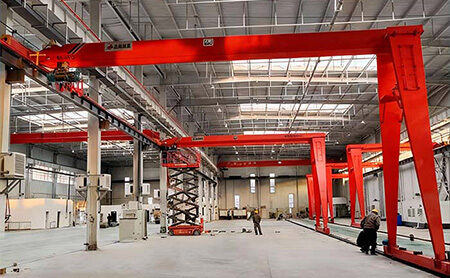
Main Structure and Core Components of Semi-Gantry Cranes
A complete semi-gantry crane system consists of several integrated assemblies, each of which directly influences lifting stability, service life, and operational safety. We primarily offer two main types: single-girder semi-gantry cranes and double-girder semi-gantry cranes. You can visit our product page to view semi-gantry crane specifications and customization options, including detailed technical drawings and parameter tables.
Main Girder
The main girder supports the entire lifting load and serves as the track for the electric hoist trolley.
- Single-Girder Semi-Gantry Crane: This is the most common choice for light-to-medium-duty applications with capacities up to 10 tons. It features a lighter dead weight, lower manufacturing costs, and easy installation. It is widely used for side-bay operations in factories, mold handling, and the transport of small steel structural components.
- Double-Girder Semi-Gantry Crane: Offering greater rigidity, superior resistance to deformation, and increased lifting height, this type can handle loads ranging from 10 to 50 tons. It can also be equipped with specialized attachments—such as electromagnetic chucks, grabs, or maintenance platforms—making it ideal for continuous, heavy-duty production lines.
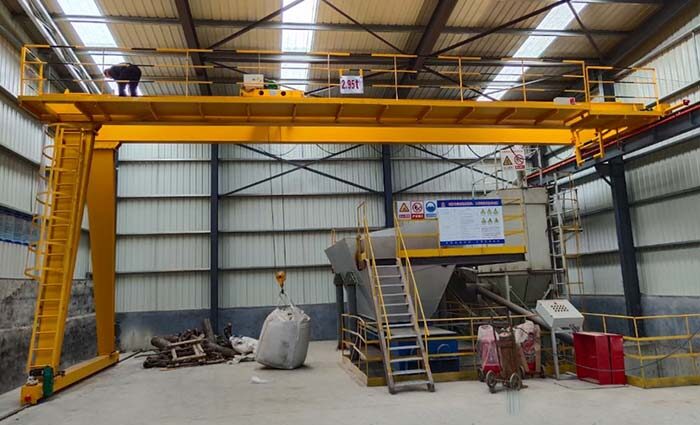
Single-Side Leg and End Carriages
The single-side leg is the most distinctive feature of a semi-gantry crane; it transfers vertical loads and horizontal travel forces to the ground-level rail foundation. The base is equipped with end carriages, wheel assemblies, buffers, and anti-derailment devices. Anti-derailment guards are critical because the asymmetrical support structure makes this type of crane more sensitive to off-center lifting (side-pulling) and uneven load distribution compared to full-gantry cranes.
Hoist Trolley and Lifting Mechanism
The hoist trolley moves laterally along the main girder. It carries either a wire-rope electric hoist or a chain hoist, enabling the vertical lifting of heavy loads. Our standard semi-gantry cranes are typically equipped with European-style wire rope hoists, ensuring smooth lifting operations. For sites with limited headroom, we offer configurations featuring low-headroom hoists.
Electrical Control System
Modern semi-gantry cranes are generally equipped with Variable Frequency Drive (VFD) systems. VFD control enables smooth starting, stopping, and speed adjustment, effectively minimizing the swaying of the load—a common challenge with single-leg gantry cranes. Operators can choose between a pendant control (push-button station) or a wireless remote control; many of our international clients prefer a dual-control setup for greater operational flexibility. The electrical control cabinet includes built-in protection against phase loss and overcurrent, as well as an emergency stop circuit.
Standard Safety Components
Every compliant semi-gantry crane must be equipped with a full suite of safety devices, including an overload limiter, upper and lower hoisting limit switches, travel limit switches for the crane, rubber buffers, an emergency stop button, a cable reel, and protective railings. For outdoor applications, wind-resistant rail clamps and anchoring devices are essential requirements.
How a Semi-Gantry Crane Works
A semi-gantry crane features three independent motions: the entire crane travels along ground-level rails, the trolley moves laterally along the main girder, and the hook performs vertical lifting and lowering.
As the crane moves through the facility, the wheels on the leg side roll along a fixed ground rail, while the upper end-carriage travels along a rail beam mounted to the building’s structure. Because the building structure bears a portion of the vertical and horizontal loads, the amount of civil engineering work required is significantly reduced. This represents a major economic advantage over a full-gantry crane, which requires two separate, dedicated concrete rail foundations.
However, there is a strict prerequisite: the existing steel beams and columns of the facility must have sufficient load-bearing capacity to support the dynamic loads of the crane. A structural analysis must be conducted prior to installation. If the existing structure cannot meet these load requirements, a semi-gantry crane is not a viable option; a full-gantry crane would be the safer choice.
Indoor vs. Outdoor Semi-Gantry Cranes
Semi-gantry cranes can be deployed both indoors and outdoors, though their configurations and protection standards differ significantly.
Indoor models are the most common, typically installed along the walls of a facility, in machining areas, or within assembly bays. Dust is the primary environmental factor; routine cleaning of electrical control cabinets and wheel bearings is usually sufficient. Indoor units generally do not require wind-protection features, unless the facility has large openings or is subject to persistent, strong cross-drafts.
Outdoor semi-gantry cranes must withstand exposure to rain, UV radiation, dust, and high winds. Consequently, they feature upgraded specifications, including heavy-duty anti-corrosion paint, sealed and rainproof electrical enclosures, protective covers for the hoist, rail clamps, and anchoring systems. When the wind speed on-site exceeds the design limit, operations must be halted and the rail clamps must be locked. Semi-gantry cranes used in coastal or rainy tropical regions also require a higher level of corrosion protection.
Key Advantages of Semi-Gantry Cranes
- Reduced Civil Engineering Costs: Requiring a ground-level rail foundation on only one side—rather than two parallel foundation trenches and dual rail lines—makes this an ideal solution for retrofitting existing industrial facilities.
- Space Efficiency: With support legs on only one side, the crane occupies minimal floor space, leaving the central aisle clear for forklifts, material carts, and personnel. This is particularly well-suited for narrow workshops or side-loading/unloading stations.
- Faster Installation: Compared to full-gantry cranes, the time required for foundation work is halved, and on-site assembly procedures are significantly simplified.
- Flexible Customization: Cranes can be tailored to your specific requirements, including existing rail beam dimensions, lifting heights, and spans. We offer customization for non-standard spans, low-headroom environments, and specific international voltage standards.
It is also important to note the limitations: the equipment relies on the existing facility structure, necessitating a structural integrity assessment before installation. It is not suitable for open-air storage yards lacking support beams, facilities with unstable structures, or locations prone to typhoons where reliable anchoring cannot be established.
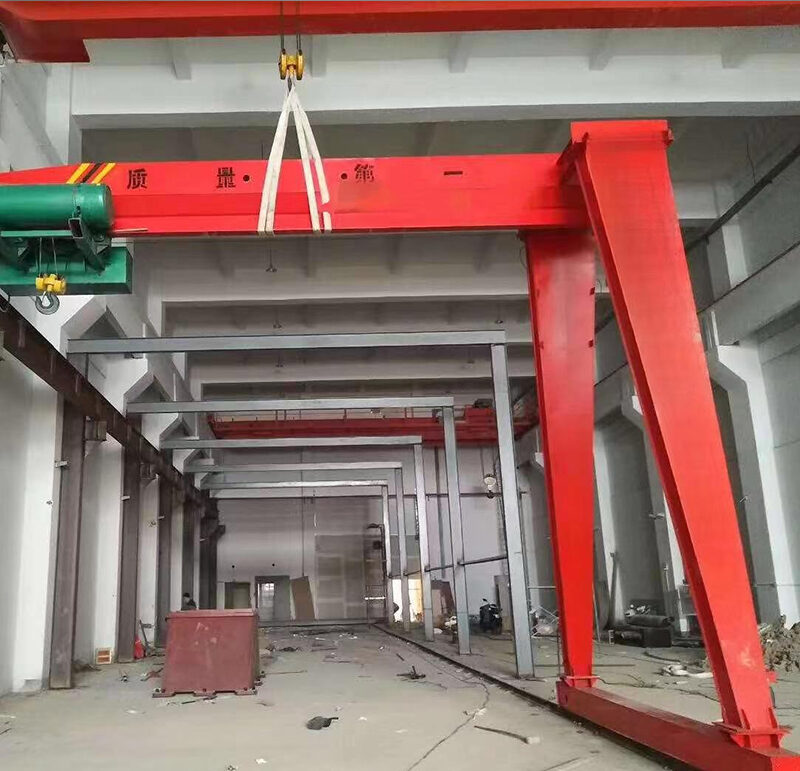
Common Industry Applications
Semi-gantry cranes are widely used in steel structure fabrication plants, mechanical machining workshops, warehousing and logistics areas, heavy equipment maintenance facilities, and precast component manufacturing plants.
Conclusion
The semi-gantry crane offers a balanced and cost-effective lifting solution, bridging the gap between overhead bridge cranes and full-gantry cranes. Its asymmetrical, single-leg design leverages existing facility infrastructure to lower foundation costs, making it an excellent choice for narrow bays and facility renovation projects. However, safe operation depends on verifying the load-bearing capacity of the facility’s rail beams, selecting the appropriate single- or double-girder model, and ensuring the inclusion of a complete suite of safety accessories.
Yuefeng Crane provides CE-certified semi-gantry cranes to clients worldwide. Our engineers can assess your facility layout, verify the load-bearing capacity of your building, and supply customized drawings, structural calculations, and pro forma invoices. If you are planning a crane project, please send us photos of the site, along with the required tonnage, span, and lifting height, and we will develop a tailored semi-gantry crane solution for you.