
When procuring heavy-duty lifting equipment for workshops or storage yards, many industrial buyers find it difficult to distinguish between gantry cranes and overhead (bridge) cranes. A gantry crane is a floor-mounted, self-supporting lifting system that relies on two vertical legs to carry the main load-bearing girder.
According to the official definition provided by the U.S. Occupational Safety and Health Administration (OSHA), a gantry crane is similar to an overhead bridge crane; the key difference is that its bridge structure is rigidly supported by two or more legs, which travel along fixed rails on the ground. While an overhead bridge crane is mounted on a building’s structural supports and columns, a gantry crane rests directly on ground-level rails, eliminating the need to rely on the facility’s roof structure to support the lifting load.
Gantry cranes can be used in both indoor and outdoor settings, finding wide application in factory workshops, storage yards, steel stockyards, precast component plants, and ports. They are designed for lifting heavy loads, with capacities ranging from several tons up to 50 tons or more.
Table of Contents
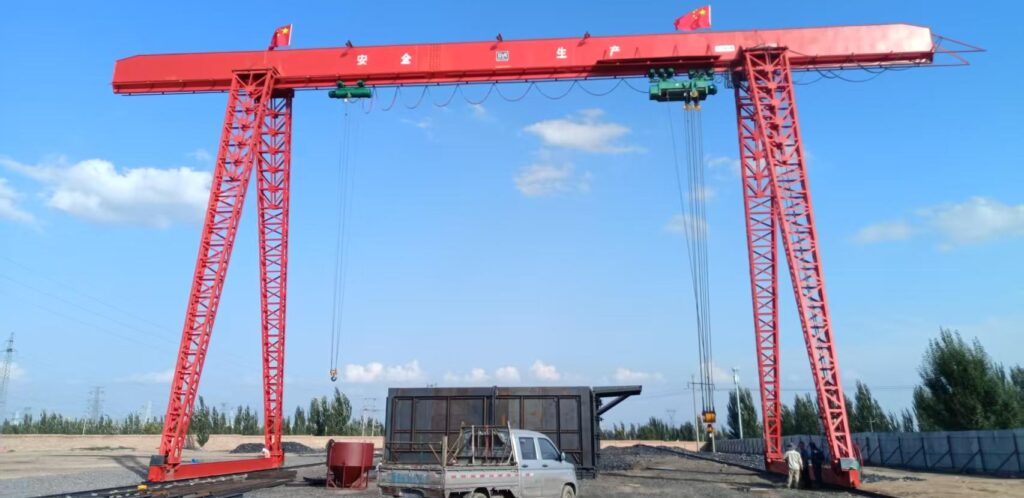
Main Components of a Gantry Crane
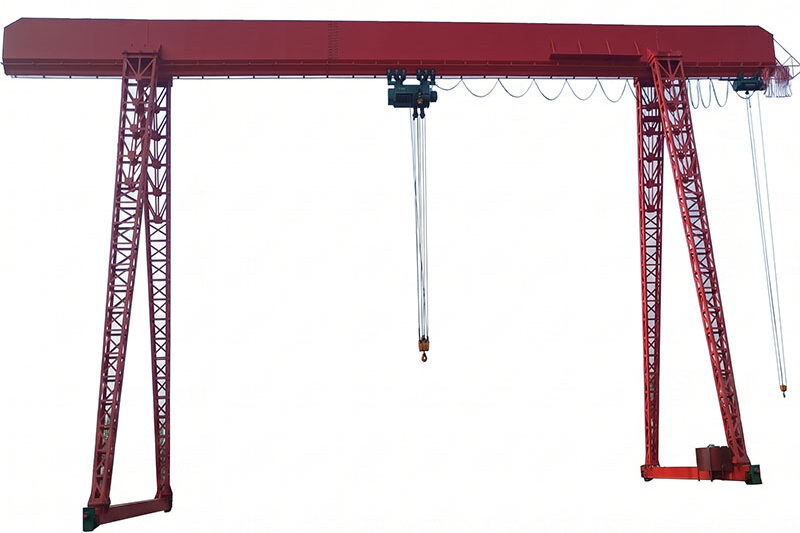
A standard gantry crane is assembled from the following core functional components:
Main girder
Box-girder structures are the preferred choice for heavy-duty applications, offering high rigidity and excellent resistance to deformation under load.
Support legs
Connects the main girder to the crane’s traveling wheels, transferring the entire load—comprising the crane’s own weight and the lifted cargo—to the ground-level rails.
Electric hoist & drum
The core hoisting component—the drum—raises and lowers loads by spooling and unspooling the wire rope.
Travelling mechanism
The drive motor and the traveling wheels propel the entire crane, moving it horizontally along a fixed track.
Common Application Scenarios
The self-supporting frame is the primary advantage of a gantry crane, allowing it to be installed in locations where an overhead bridge crane cannot be set up.
Factory workshop: Hoisting steel plates, mechanical components, and finished equipment
Outdoor storage yard: loading and unloading of steel raw materials and precast concrete components
Ports and logistics yards: handling heavy cargo and container-related materials.
Construction site: Transporting raw construction materials and prefabricated structural components
Gantry Cranes vs. Overhead Cranes: Key Differences
Installation Requirements
Gantry cranes are equipped with their own supporting legs and operate on ground-level rails; they do not require the building’s structural framework to bear their load and can even be installed in outdoor areas. In contrast, bridge cranes are mounted onto the structural columns of a facility; they rely on a robust building structure for support and are intended for indoor use only.
Applicable Scenarios
Gantry cranes can be used both indoors and outdoors, making them suitable for storage yards and temporary construction sites; bridge cranes, by contrast, are restricted to use within enclosed workshops and cannot operate outdoors.
Operating Range
Gantry cranes can be equipped with cantilevers at both ends, allowing for a larger working area; the operating range of bridge cranes is limited to the space between the factory building’s columns.
Operating Range
Gantry cranes can be equipped with cantilevers at both ends, allowing for a larger working area; the operating range of bridge cranes is limited to the space between the factory building’s columns.
You can also consult OSHA’s official regulations regarding overhead crane and gantry cranes to understand the differences between the two.
Customized Gantry Crane Solutions
Shandong Yuefeng Lifting Machinery Co., Ltd. (China) provides custom-manufactured gantry cranes for industrial clients worldwide. Prior to shipment, we supply a complete set of technical drawings along with professional technical support.
We can tailor the span, lifting height, overhang structure, and rated lifting capacity to suit the specific operating conditions at your site. Our engineering team will verify all parameters and provide drawings for your approval before production begins.
Contact us And Get a Quote:+8618864822072