
The EOT crane (Electric Overhead Traveling Crane) is the most prevalent type of overhead heavy-duty material handling equipment in industrial settings, widely used across sectors such as manufacturing, warehousing, metallurgy, energy, and logistics. Powered by electricity and operating along rails mounted at the top of the facility, it occupies no floor space while enabling the vertical lifting and precise horizontal transport of heavy loads, serving as the “aerial workhorse” of modern industrial logistics and production assembly.
Table of Contents
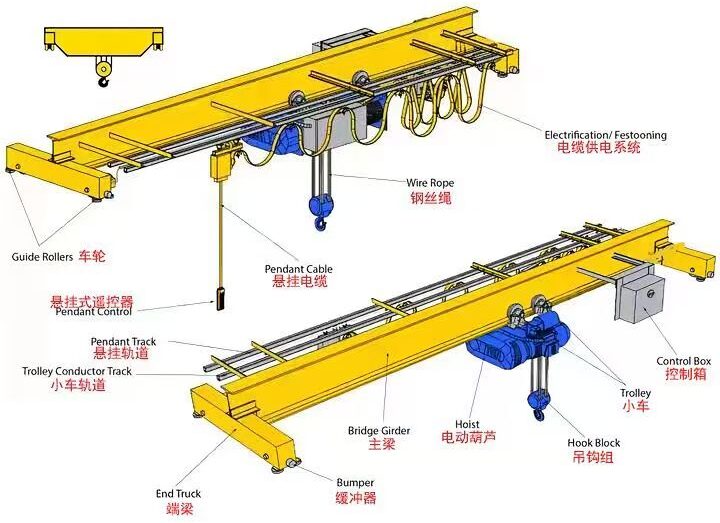
Main Components of an EOT Crane
Structurally, an EOT crane consists primarily of five core components: the bridge, the trolley, the hoisting mechanism, the travel mechanism, and the electrical control system. The bridge moves longitudinally along rails on both sides of the facility, while the trolley moves transversely along the bridge’s main girder; the hoisting mechanism handles the vertical lifting and lowering of loads. Working in concert, these components create a three-dimensional operating envelope that covers the entire rectangular area of the facility.
Compared to traditional forklifts and gantry cranes, EOT cranes offer significant advantages: overhead operation avoids interfering with ground-level personnel and equipment, thereby maximizing space utilization; electric drives ensure clean, low-noise operation and reduced maintenance costs; and integration with remote controls, PLCs, and intelligent monitoring systems enables automated operations, supporting the transition to smart manufacturing. As fundamental equipment for industrial material handling, EOT cranes are rapidly evolving from traditional mechanical control toward digitalization, intelligence, and automation, serving as a key enabler of efficient, safe, and flexible factory production.
How Does an EOT Crane Work?
Core operational logic of an EOT crane:By coordinating three independent movements, the system achieves the spatial positioning and transfer of heavy loads; the motion is precise and highly controllable, making it a classic mechanical solution for industrial heavy-duty material handling.
First movement
Hoisting motion (vertical). The core mechanism consists of a hoist motor, a gearbox, a drum, a wire rope or chain, and a hook assembly. The motor drives the drum to rotate via the gearbox, winding or unwinding the wire rope to raise or lower the hook; a brake is used to lock the load in a stationary position, ensuring stable and safe vertical movement of heavy loads. This constitutes the “core lifting function” of the EOT crane.
Second movement
Trolley traverse (lateral movement). The trolley, which carries the hoisting mechanism, travels along the rails of the bridge girder; its wheels are driven by a dedicated motor to achieve precise positioning of the load across the width of the facility, thereby meeting lateral transfer requirements for various workstations and cargo locations.
Third movement
The longitudinal travel of the bridge (moving in the forward and backward directions). Travel mechanisms mounted on the end trucks at both ends of the bridge move along rails embedded in the upper structure of the facility, covering the entire length of the building and enabling the long-distance transfer of materials between different workshops and processing stages.
In terms of control, EOT cranes support three operating modes: ground-based pendant controls, cabin controls, and wireless remote controls. Modern models are typically equipped with safety features such as PLC control systems, limit switches, and protections against overload, undervoltage, and collisions. The three primary motion mechanisms can operate independently or in coordination, ensuring high positioning accuracy and smooth operation. Simply put, by issuing commands to coordinate these mechanisms, operators can smoothly and precisely transport heavy loads from any starting point to any target location, thereby executing end-to-end tasks such as loading and unloading, assembly, maintenance, and warehousing.
Industrial Applications
Thanks to their heavy-duty capabilities, high efficiency, and space-saving design, EOT cranes have permeated various industrial sectors, becoming standard equipment for production and maintenance operations across diverse industries. The following is an analysis of their core application scenarios.
Metallurgy and Steel Industry
EOT cranes are indispensable core equipment in steel plants, used for transporting steel billets, coils, and plates, as well as for lifting smelting furnaces and ladles. Key requirements include high-temperature resistance, protection against splashes, and high reliability; heavy-duty double-girder EOT cranes are the primary models used.
Equipment Manufacturing and Machining
In manufacturing environments such as those for machine tools, construction machinery, and pressure vessels, these systems handle tasks including the lifting of large components, equipment assembly, mold changing, and finished product warehousing; single- and double-girder models are configured as needed to ensure the continuous operation of production lines.
Automotive Manufacturing
Used for the transport and assembly of heavy components—such as vehicle body assemblies, engines, and chassis—this equipment integrates with automated production lines to enable paced operations, thereby enhancing the efficiency and consistency of vehicle assembly.
Warehousing and Logistics
Enables high-level storage and retrieval of pallets and heavy loads in warehouses with heavy-duty racking and logistics centers, enhancing storage density and operational efficiency; suitable for specialized logistics sectors such as large-item handling, cold chain, and construction materials.
Ports and Shipbuilding
In dry docks and port workshops, long-span, heavy-duty EOT cranes handle the lifting of hull sections and port machinery components, supporting the construction and maintenance of large-scale equipment.
Furthermore, in sectors such as mining, cement production, aerospace, and rail transportation, EOT cranes utilize customized solutions to meet handling requirements involving heavy loads, challenging environments, and stringent safety standards, serving as highly versatile foundational equipment within the industrial landscape.
EOT Crane Safety, Maintenance, and Intelligent Upgrading
As heavy-duty specialized equipment, EOT cranes rely on safety and maintenance for stable operation; meanwhile, intelligent upgrades are emerging as an industry trend, driving the evolution of the equipment from merely “functional” to “user-friendly and durable.”
Regarding safety management, regular inspections must be strictly enforced: daily checks of brakes, limit switches, wire ropes, hooks, and rails; monthly inspections of motors, gear reducers, couplings, and electrical wiring; and annual comprehensive inspections and load testing. Operators must be certified and strictly adhere to the “Ten No-Lift Rules.” Mandatory safety devices—such as overload limiters, travel limiters, anti-collision systems, and emergency stops—must be installed to eliminate improper operations and the use of defective equipment. For further information on bridge crane inspections, safety configurations, and operating procedures, please consult the authoritative eCFR standards via the OSHA official safety regulations for overhead and gantry cranes.
Regarding operations and maintenance, standardized procedures should be established for lubrication, the replacement of wear parts, and troubleshooting. This includes the periodic lubrication of bearings, gears, and drums; the timely replacement of worn wire ropes, hooks, and brake pads; and the cleaning of electrical cabinets and inspection of wiring insulation to prevent short circuits and electrical leakage. Standardized maintenance can significantly extend equipment lifespan while reducing failure rates and downtime-related losses. When purchasing or upgrading EOT cranes, many enterprises opt for professional manufacturers that offer one-stop solutions; Yuefeng Lifting provides customized EOT crane design, manufacturing, installation, and full-lifecycle maintenance support tailored to the heavy-duty lifting requirements of various industries.
In terms of intelligent upgrades, EOT cranes are integrating into Industry 4.0: IoT sensors enable real-time monitoring of operational data; remote control and semi- or fully automatic positioning capabilities boost operational efficiency; anti-sway control and precision alignment algorithms enhance handling accuracy; and predictive maintenance provides early fault warnings, reducing unplanned downtime.
Safety is the baseline, operations and maintenance provide the guarantee, and intelligence represents the future direction. By effectively managing the entire lifecycle, EOT cranes can consistently provide stable, efficient, and safe heavy-load handling support for industrial production, serving as core equipment that helps enterprises reduce costs and boost efficiency.
Why Many Factories Prioritize Electric Bridge Cranes
In the field of industrial lifting, there is a wide variety of equipment—such as gantry cranes, mobile cranes, forklifts, and jib cranes—used for handling heavy loads; however, the EOT crane (electric overhead traveling crane) remains the preferred choice for heavy-duty operations within factory facilities.
EOT cranes operate on rails mounted in the upper structure of the factory building, occupying no floor space; this allows for the flexible placement of machine tools, materials, and workstations on the ground, thereby maximizing the utilization of the facility’s space. While mobile truck cranes offer high mobility and are suitable for temporary outdoor lifting tasks, they are not viable for permanent, long-term use within a workshop, and the cost of continuous operation is high. Forklifts are suitable for transporting light-to-medium loads over short distances but have limited lifting heights, making them inadequate for handling heavy workpieces weighing tens of tons or for transferring loads between workstations at height. Jib cranes cover only a limited, fan-shaped area and have a restricted operating range, making them suitable only for auxiliary lifting at a single workstation.
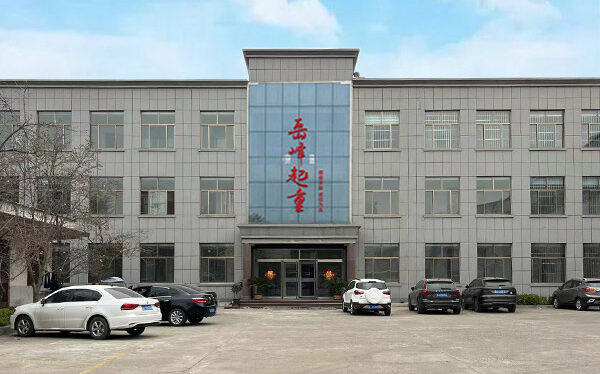
At Yuefeng Hoisting Machinery, we have been manufacturing cranes for 20 years. Understanding that every factory has unique lifting requirements, we specialize in providing practical, customized hoisting solutions. We exercise strict control over every critical stage—from steel preparation, cutting, welding, and assembly to painting, testing, and final inspection—prior to delivery.
If you are planning to install an EOT crane in a factory or warehouse, we invite you to contact us or visit our website to learn more about us.