
When factories, workshops, and warehouses need a reliable way to move materials, choosing the right lifting equipment is essential. A single girder overhead crane is one of the most widely considered solutions for light and medium-duty material handling.
With a compact structure, flexible configuration, and relatively simple maintenance requirements, this type of overhead crane can be adapted to many industrial applications. But what exactly is a single-girder crane, and how do you know whether it is suitable for your project?
This guide explains its structure, working principle, advantages, applications, and the key factors to consider before purchasing.
Table of Contents
What Is a Single Girder Overhead Crane?
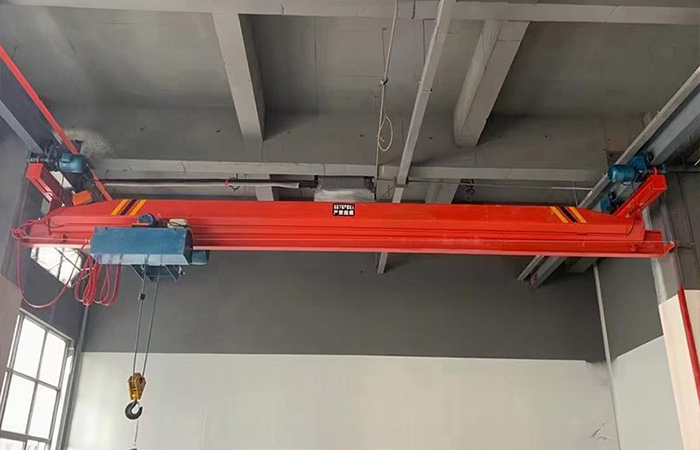
A single girder overhead crane is a bridge-type lifting system that uses one main girder to support an electric hoist. The crane travels along runway rails installed inside a workshop, factory, warehouse, or other industrial building.
Unlike a double-girder crane, which uses two main beams, the single-girder design has a simpler structure and is generally suitable for light to medium lifting requirements.
The crane can be customized according to lifting capacity, span, lifting height, traveling speed, working frequency, and workshop conditions.
For many general material-handling applications, this makes a single-girder system a practical balance between performance and investment.
How Does a Single Girder Overhead Crane Work?
The basic operation combines vertical lifting with horizontal movement.
The electric hoist raises and lowers the load, while the crane bridge travels along the runway. The hoist can also move horizontally along the main girder, allowing operators to position the load within the crane’s working area.
This three-directional movement makes overhead lifting much more efficient than manually moving heavy materials across the factory floor.
For safe operation, the crane should be selected according to the actual load, working environment, lifting method, and operating conditions. The UK Health and Safety Executive provides useful guidance on planning lifting operations and selecting suitable lifting equipment. HSE: Safe use of lifting equipment
Main Components
A typical single girder overhead crane includes several key components:
- Main girder
- End trucks
- Electric hoist
- Traveling mechanism
- Electrical control system
- Runway system
- Limit switches
- Pendant or remote control
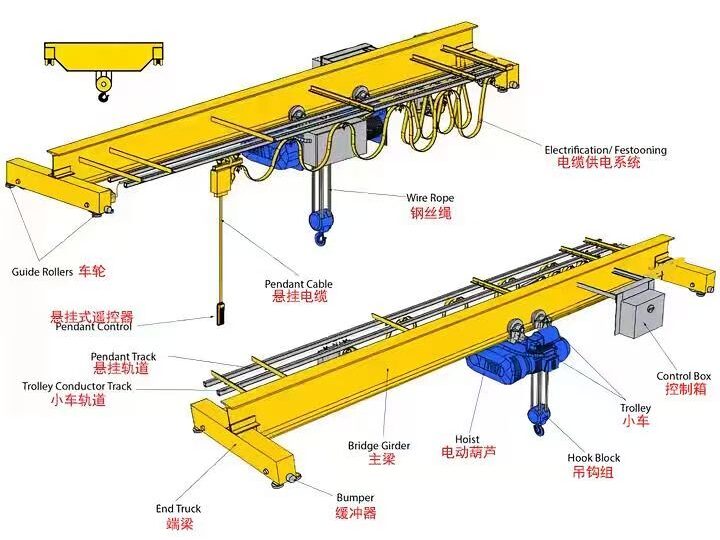
Each component contributes to the overall performance and reliability of the crane. Therefore, the crane should be engineered as a complete system rather than selecting individual components only according to price.
Key Advantages
One of the biggest benefits of a single girder overhead crane is its compact structure.
Compared with heavier crane configurations, the single-girder design can reduce structural weight while still providing effective material handling for suitable applications.
Other advantages include:
Cost-Effective Design
For light and medium-duty lifting, a single-girder crane can offer a competitive investment without adding unnecessary structural capacity.
Efficient Space Utilization
Because the crane operates above the production floor, it can help reduce the need for additional floor-based handling equipment.
Easy Maintenance
The relatively straightforward structure makes routine inspection and maintenance more manageable.
Flexible Customization
Crane capacity, span, lifting height, control method, speed, and electrical configuration can be customized according to the project.
Smooth Material Handling
With appropriate motors, controls, and mechanical components, the crane can provide stable movement for routine industrial lifting operations.
Common Industrial Applications
A single girder overhead crane can be used in many industries and working environments.
Typical applications include:
- Manufacturing workshops
- Machinery factories
- Automotive parts plants
- Metal processing facilities
- Warehouses
- Assembly workshops
- Equipment maintenance areas
- General material handling facilities
For example, a manufacturing plant may use the crane to move steel components, molds, motors, machinery parts, or finished products between different working areas.
Its actual suitability depends on the required load capacity, working frequency, building structure, and operating environment.
How to Choose the Right Crane
Choosing the correct crane requires more than knowing the maximum load.
Before requesting a quotation, buyers should prepare several important specifications.
1. Lifting Capacity
Determine the maximum weight that needs to be lifted. The rated capacity should match the actual application and applicable safety requirements.
2. Span
Measure the distance between the runway rails. The span determines how much working area the crane can cover.
3. Lifting Height
Consider the required hook height, building height, roof structure, and available headroom.
4. Working Frequency
A crane used occasionally for maintenance will have different requirements from one operating continuously on a production line.
5. Power Supply
For international projects, provide the local voltage and frequency so the electrical system can be configured correctly.
6. Control Method
Depending on the application, pendant control, remote control, or other control solutions can be considered.
Providing these details allows the manufacturer to develop a more accurate technical proposal and avoid unnecessary specifications.

Why Choose Yuefeng as Your Crane Manufacturer?
At Yuefeng, we have been manufacturing cranes for around 20 years. We focus on designing and producing reliable lifting equipment for factories, workshops, warehouses, and other industrial applications.
When we manufacture a single girder overhead crane, we don’t simply provide a standard product. We first understand our customer’s lifting capacity, span, lifting height, working frequency, and workshop layout, then develop a suitable solution based on the actual requirements.
From steel preparation and welding to assembly, painting, inspection, and testing, we carefully control each stage of production. Our goal is to provide a single girder overhead crane that offers reliable performance, easy maintenance, and good long-term value.
If you are planning a new crane project, send us your requirements or workshop drawings. Our technical team will help you find a practical and cost-effective solution