
Table of Contents
Introduction
Choosing the right crane for your workshop is a critical decision that affects efficiency, safety, and cost. Gantry cranes and bridge cranes are two of the most common solutions, but each serves different workshop scenarios. Picking the wrong type can increase operational risk, reduce workflow efficiency, and raise long-term costs.
This guide consolidates engineering best practices, real-world operational experience, and technical insights to help you make an informed choice. By understanding the differences, applications, and decision criteria, you can select the crane that best fits your workshop. For deeper dives, you can refer to Gantry Crane for Workshops and Bridge Crane for Workshops.
What Is a Gantry Crane

A gantry crane consists of a horizontal beam supported by legs, which move along floor rails or wheels. The hoist moves along the beam, allowing you to lift and transport loads across the workshop. Gantry cranes are particularly useful in workshops where the building structure cannot support overhead cranes or where mobility is required for temporary lifting zones.
Because gantry cranes are floor-supported, they can be relocated as workflow requirements change, making them ideal for workshops with flexible layouts or evolving production needs. They are commonly installed indoors and outdoors, and their modular design allows customization based on load requirements and span lengths.
Types of Gantry Cranes
- Single Girder Gantry Crane: Designed for light to medium loads, it offers low installation costs and simple maintenance. Best for small workshops and occasional lifting tasks.
- Double Girder Gantry Crane: Supports heavier loads and longer spans. Suitable for repetitive and heavier-duty operations, providing stability and longer service life.
- Mobile Gantry Crane: Flexible design allows repositioning across different workshop areas, which is ideal for multi-use spaces or projects that require temporary lifting zones.
- Fixed Gantry Crane: Runs on floor rails and is perfect for repetitive workflows. Offers higher lifting stability and is commonly used in production lines with predictable lifting paths.
Typical Applications
- Moving raw materials, semi-finished components, and finished products efficiently
- Assisting in equipment assembly where precise positioning of heavy components is required
- Maintenance and repair tasks for motors, molds, dies, and other tools
- Controlled lifting for the installation of machinery and equipment without damaging the infrastructure
Gantry cranes are particularly effective for workshops that need flexible, mobile lifting solutions, and they can complement permanent systems for hybrid workflows.
What Is a Bridge Crane

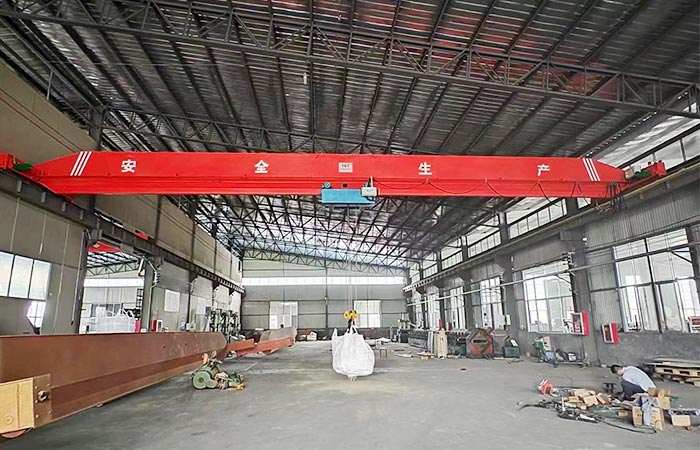
A bridge crane, or overhead crane, travels along rails mounted on the building structure. The hoist moves along the bridge beam to lift and transport materials horizontally and vertically across the workshop. Bridge cranes are optimal for environments where frequent, heavy-duty lifting is needed and floor space must remain clear.
Bridge cranes are commonly used in production-focused workshops and assembly lines because they can handle continuous operation while minimizing operator fatigue and workflow interruptions. Their permanent installation ensures reliable performance and high positional accuracy for sensitive or heavy loads.
Types of Bridge Cranes
- Single Girder Bridge Crane: Best for light to medium loads. It is simpler to install and maintain and has lower upfront costs, making it suitable for smaller workshops or moderate lifting operations.
- Double Girder Bridge Crane: Supports heavier loads and longer spans, allowing higher lifting heights. Suitable for high-frequency and heavy-duty operations, providing greater stability and reliability.
Typical Applications
- Supplying materials to production lines consistently, minimizing workflow interruptions
- Precision assembly, ensuring components are positioned accurately
- Handling molds, dies, and tools safely, reducing risk of damage and improving efficiency
- Maintenance operations for heavy machinery and components
Bridge cranes excel in high-throughput operations where operational efficiency and floor space optimization are priorities.
Gantry Crane vs Bridge Crane: Key Differences
| Factor | Gantry Crane | Bridge Crane |
|---|---|---|
| Installation | Floor-supported, flexible | Building-supported, permanent |
| Mobility | High, can be moved | Fixed |
| Floor space | Legs occupy space | Floor fully free |
| Load Capacity | Moderate to heavy | Medium to very heavy |
| Best Use | Temporary or flexible layouts | High-frequency, heavy-duty lifting |
| Maintenance | Simpler, fewer structural constraints | Requires structural inspections and preventive care |
Understanding these differences is critical for aligning crane choice with actual workshop requirements rather than theoretical maximums.
Workshop Scenario Recommendations
- Small or Flexible Workshops: Gantry cranes are ideal due to their mobility and easy installation. They can be relocated as workflows change, which reduces downtime.
- High-Frequency Production: Bridge cranes allow continuous lifting without occupying floor space, optimizing workflow and minimizing congestion.
- Limited Floor Space: Bridge cranes free up the working area for other equipment and processes, making them better suited for dense workshop layouts.
- Outdoor or Multi-Purpose Areas: Gantry cranes are more adaptable for outdoor lifting or temporary applications. Bridge cranes require structural support and are typically confined to indoor use unless special runways are installed.
Technical Considerations
| Parameter | Why It Matters |
|---|---|
| Load capacity | Ensures safe handling of all operational loads |
| Span | Determines how much of the workshop is covered |
| Lifting height | Must accommodate equipment and workflow requirements |
| Duty class | Reflects operational frequency and intensity, critical for longevity |
| Hoist speed | Directly impacts productivity and efficiency |
| Control method | Pendant or remote control affects usability and safety |
Safety Features
Modern cranes include multiple protective systems to ensure operator safety and prolong service life: overload protection, limit switches, emergency stop functions, smooth acceleration and deceleration, anti-sway mechanisms, and periodic inspection protocols.
Proper training and preventive maintenance are essential to ensure safe operation, reduce downtime, and maintain crane accuracy over the long term.

Gantry Crane vs Bridge Crane: Cost and Long-Term Value
- Gantry Cranes: Lower initial investment, flexible, mobile, and suitable for smaller workshops or temporary lifting setups.
- Bridge Cranes: Higher upfront cost but optimized for high-frequency, heavy-duty operations. They improve long-term efficiency and maximize floor space usage.
Consider the total cost of ownership, including operational efficiency, maintenance, energy consumption, and safety compliance. Well-chosen cranes reduce labor, prevent workflow bottlenecks, and minimize the risk of accidents.
Common Selection Mistakes
- Selecting cranes too large or too small for actual workflow
- Ignoring duty class, leading to premature wear
- Neglecting floor space, headroom, and building structural constraints
- Skipping expert consultation or technical guidance
Avoiding these mistakes can save significant costs and prevent operational disruption.
Conclusion
Both gantry and bridge cranes provide essential lifting solutions for modern workshops. The best choice depends on load weight, lifting frequency, floor space, workflow flexibility, and long-term operational goals.
If you want professional guidance to select the right crane for your workshop and optimize efficiency, safety, and long-term value, contact us today.
FAQ
Can gantry cranes handle heavy loads?
Yes, especially double girder or large mobile gantry cranes. For continuous very heavy lifting, bridge cranes are better.
Are bridge cranes suitable for small workshops?
Yes, if the building structure allows safe installation. Gantry cranes may be more practical in limited-structure scenarios.
Can both types be used in the same workshop?
Yes. Many workshops combine bridge cranes for permanent high-frequency zones with gantry cranes for flexible or temporary lifting areas.
How do maintenance requirements differ?
Gantry cranes require simpler maintenance. Bridge cranes require structural inspections, preventive maintenance, and operator training to ensure long-term reliability.