

When searching for “what is a gantry crane used for,” you’re likely looking for clear, practical answers about how these versatile lifting systems operate across different industries. Gantry cranes have become indispensable in modern material handling, offering unmatched mobility and flexibility compared to fixed overhead crane systems. Unlike traditional overhead cranes that require building-mounted runways, gantry cranes stand on their own legs and can move on rails or wheels, making them suitable for both indoor and outdoor applications.
This comprehensive guide breaks down 10 key industrial applications of gantry cranes, explains different types available in the market, and provides practical insights to help you choose the right system for your specific needs. Whether you’re in construction, manufacturing, ports, or maintenance operations, understanding gantry crane uses can significantly improve your material handling efficiency and workplace safety.
Table of Contents
What Is a Gantry Crane? A Quick Definition
A gantry crane is a type of crane where the hoist and trolley move along a bridge or girder supported by freestanding legs that run on rails, wheels, or casters. This self-supporting structure eliminates the need for building-mounted runways, allowing the crane to operate in areas where overhead cranes cannot be installed. The term “gantry” refers to the overarching framework that holds all crane components together, providing stability for safe and efficient lifting operations.
The fundamental difference between gantry cranes and overhead cranes lies in their support structure. Overhead cranes are suspended from building ceilings or support beams, while gantry cranes stand independently on the ground. This key distinction gives gantry cranes superior mobility and adaptability, making them ideal for outdoor applications, temporary job sites, and facilities with structural limitations. Gantry cranes come in various configurations including single girder, double girder, semi-gantry, portable, rail-mounted, and rubber-tyred designs, each optimized for specific applications and load requirements.
What Is a Gantry Crane Used For? 10 Key Gantry Crane Uses Across Industries
Application 1 – Construction
In the construction industry, gantry cranes play a crucial role in handling heavy materials that would be difficult or impossible to move manually. They are extensively used for lifting steel beams, concrete slabs, prefabricated bridge sections, and other structural components during building construction, bridge projects, and tunnel operations. For example, in tunnel construction projects, double girder gantry cranes with spans up to 40 meters and lifting heights of 80 meters are used to remove waste materials and transport concrete segments deep within confined tunnel spaces.
Construction gantry cranes provide several advantages including precise load positioning, the ability to work in areas with limited overhead clearance, and the flexibility to move materials horizontally and vertically across the job site. Mobile gantry cranes are particularly valuable in construction because they can be repositioned as the project progresses, following work areas without requiring permanent installations. This adaptability makes them essential for infrastructure projects where lifting needs change throughout different construction phases.
Application 2 – Manufacturing and Assembly
Manufacturing facilities rely heavily on gantry cranes to streamline production processes and improve assembly line efficiency. These cranes handle everything from moving raw materials to workstations to transporting finished products between production stages. In automotive manufacturing plants, gantry cranes lift car engines, body panels, and transmission components onto assembly lines with precision that manual handling cannot match. Similarly, in steel processing plants, they move heavy steel coils, plates, and finished products through various production stages.
The integration of gantry cranes in manufacturing operations significantly reduces worker strain, minimizes the risk of workplace injuries, and increases throughput by enabling continuous material flow. Semi-gantry cranes are particularly useful in manufacturing environments with limited floor space, as they can be mounted against existing walls or structures while still providing full lifting capacity on one side. This design maximizes available workspace and allows facilities to optimize their production layouts without compromising material handling capabilities.
Application 3 – Ports and Container Terminals
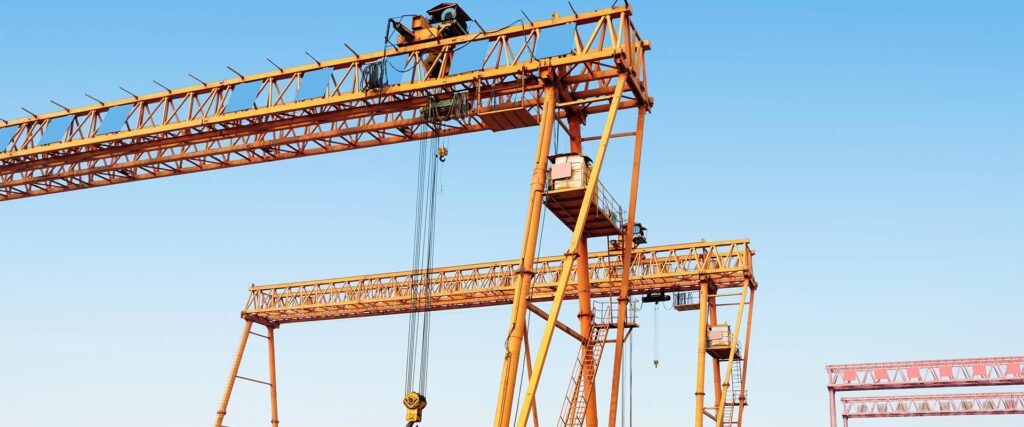
Port operations represent one of the most prominent applications of gantry cranes, specifically designed for high-speed container handling. Rail Mounted Gantry (RMG) cranes and Rubber-Tyred Gantry (RTG) cranes are the backbone of modern container terminals, responsible for loading and unloading containers from ships, stacking them in yards, and transferring them to trucks or rail cars. These cranes can handle 20-foot, 40-foot, and 45-foot containers with capacities typically ranging from 30 to 65 tons.
The impact of gantry cranes on port efficiency is substantial. They enable rapid container turnover, reduce vessel turnaround times, and maximize yard space utilization through vertical stacking capabilities. RMG cranes, operating on fixed rails, provide precise positioning and are ideal for densely packed container yards with high throughput requirements. RTG cranes, with their rubber tires, offer greater flexibility for reconfiguring yard layouts and can move containers across different storage areas without being constrained to fixed tracks. Both types have become essential for supporting global trade and supply chain operations.
Application 4 – Warehousing and Logistics
In warehousing and logistics environments, gantry cranes serve as efficient material handling solutions that complement traditional forklift operations. They are particularly valuable for handling heavy or awkwardly shaped items that are difficult to move with forklifts, such as long steel pipes, large machinery, pallets of dense materials, and irregular cargo. Portable gantry cranes can be easily moved between different workstations or storage areas, providing flexible lifting capabilities throughout the warehouse facility.
The benefits of using gantry cranes in warehouses include improved space utilization, reduced congestion in narrow aisles, and enhanced safety when handling heavy loads. Unlike forklifts, gantry cranes can lift loads vertically without requiring aisle width for turning, allowing for denser storage configurations. Additionally, they can load and unload trucks directly from the dock area, streamlining inbound and outbound logistics operations. For warehouses with high ceilings, full gantry cranes with adjustable heights can optimize vertical space usage, increasing overall storage capacity while maintaining efficient material flow.
Application 5 – Shipbuilding and Marine
Shipbuilding and marine operations utilize specialized gantry cranes designed for extreme lifting capacities and precision handling. Shipyard gantry cranes, also known as Goliath cranes, can lift loads ranging from 100 to 600 tons with spans up to 185 meters, making them capable of handling massive ship sections, engines, and complete vessel assemblies. These cranes are essential for constructing and launching ships, as well as performing maintenance operations on vessels out of water.
The unique requirements of shipbuilding applications demand cranes with exceptional stability, precise load positioning, and the ability to withstand harsh marine environments. Double girder gantry cranes with multiple trolleys are commonly used to lift large ship sections from fabrication areas to assembly positions, ensuring accurate alignment during hull construction. The mobility of these cranes allows shipyards to efficiently move materials across large work areas, while their robust construction ensures safe operation even in coastal conditions with high wind loads and corrosive atmospheres.
Application 6 – Mining and Heavy Industry
Mining operations and heavy industrial facilities require gantry cranes capable of handling extremely heavy loads in challenging environments. In mining, gantry cranes are used to lift and move heavy equipment such as excavators, drilling rigs, ore containers, and processing machinery. They play a critical role in both surface and underground mining operations, where they transport materials from extraction points to processing areas or loading stations.
The harsh conditions of mining environments demand gantry cranes with reinforced construction, corrosion-resistant coatings, and heavy-duty components capable of withstanding dust, vibration, and continuous operation. Grab bucket gantry cranes are particularly valuable in mining for handling bulk materials like coal, ore, and gravel efficiently. These cranes can move thousands of tons of material per day, significantly improving operational efficiency and reducing reliance on manual labor or truck-based transport within mining facilities.
Application 7 – Power Plants and Utilities
Power plants and utility facilities rely on gantry cranes for critical maintenance and assembly operations involving massive components such as turbines, generators, transformers, and condensers. These operations require precise lifting capabilities and absolute safety, as mishandling could result in catastrophic equipment damage or extended downtime. Gantry cranes used in power plants are designed with high load capacities, typically ranging from 50 to 200 tons, and equipped with advanced safety features including overload protection, anti-sway systems, and precision controls.
The specialized requirements of power plant applications include the need for cranes that can operate in confined spaces, handle irregularly shaped equipment, and provide millimeter-level positioning accuracy during assembly and maintenance procedures. Portable gantry cranes are particularly useful for routine maintenance tasks, allowing maintenance teams to quickly set up lifting equipment at different locations throughout the facility. For major overhauls, larger double girder gantry cranes provide the stability and capacity needed to lift and position heavy components for inspection, repair, or replacement.
Application 8 – Precast Concrete Production
Precast concrete production facilities depend heavily on gantry cranes for efficient handling of concrete products throughout the manufacturing process. These cranes transport heavy concrete beams, slabs, panels, and other prefabricated components from casting beds to curing areas, then to storage yards, and finally to loading areas for shipment. The repetitive nature of precast operations requires cranes with high duty cycles, precise control, and the ability to handle multiple loads efficiently.
Gantry cranes used in precast concrete production typically feature lifting capacities ranging from 10 to 70 tons, with spans customized to match the facility layout. They are equipped with specialized lifting attachments such as spreader beams and clamps designed to safely handle concrete products without causing damage. The ability to stack concrete components vertically using gantry cranes maximizes storage capacity and reduces the facility’s footprint. Additionally, the precise control offered by modern gantry crane systems ensures accurate placement of concrete elements during loading and unloading, reducing the risk of damage and improving overall production efficiency.
Application 9 – Maintenance and Repair Workshops
Maintenance and repair workshops across various industries rely on portable gantry cranes for their flexibility and ease of use. These cranes are essential for lifting motors, pumps, gearboxes, and other heavy equipment during inspection, repair, or replacement procedures. Unlike permanent crane systems, portable gantry cranes can be quickly assembled, positioned, and disassembled as needed, making them ideal for facilities with multiple workstations or temporary maintenance requirements.
The versatility of portable gantry cranes makes them valuable assets in automotive repair shops, industrial maintenance bays, HVAC service operations, and equipment refurbishment facilities. Their adjustable height and span configurations allow technicians to customize the crane to fit specific work environments and lifting requirements. The mobility of these cranes enables maintenance teams to bring lifting capabilities directly to the equipment requiring service, rather than moving heavy equipment to fixed lifting stations. This flexibility reduces downtime, improves workshop efficiency, and enhances worker safety by eliminating manual handling of heavy loads during maintenance procedures.
Application 10 – Aerospace and Specialized Industries
Aerospace manufacturing and other specialized industries require gantry cranes with exceptional precision and clean operation capabilities. In aerospace applications, gantry cranes are used to handle large aircraft components including wings, fuselages, engines, and tail sections during assembly and maintenance operations. These cranes must provide smooth, vibration-free movement and precise positioning accuracy to ensure the quality and integrity of aircraft assemblies.
Clean room gantry cranes are specifically designed for aerospace, semiconductor manufacturing, pharmaceutical, and food processing industries where contamination control is critical. These cranes feature specialized materials, coatings, and filtration systems that meet strict cleanliness standards while providing reliable lifting performance. The customization options available for specialized gantry cranes allow them to be tailored to unique industry requirements, including explosion-proof designs for hazardous environments, corrosion-resistant construction for marine applications, and temperature-controlled systems for cold storage facilities.
Gantry Crane Types and Their Best Use Cases
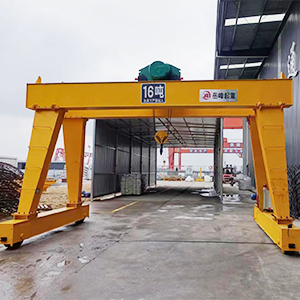
Understanding the different types of gantry cranes available is essential for selecting the right equipment for your specific application needs. Single girder gantry cranes are cost-effective solutions for light to moderate lifting requirements, typically handling loads up to 20 tons. They are ideal for warehouses, workshops, and manufacturing facilities with smaller budgets and less demanding lifting needs. Double girder gantry cranes, with their parallel beam construction, offer greater stability and lifting capacities, making them suitable for heavy-duty applications in shipyards, steel mills, and large construction projects.
Semi-gantry cranes combine features of both overhead and gantry cranes, with one side supported by legs and the other mounted on a building structure. This design is perfect for facilities with limited floor space or where one side of the work area can utilize existing wall support. Portable gantry cranes provide maximum mobility for maintenance and light manufacturing applications, with capacities ranging from 0.5 to 10 tons and adjustable heights and spans. Rail-mounted gantry cranes (RMG) offer precise positioning for container terminals and intermodal facilities, while rubber-tyred gantry cranes (RTG) provide flexibility for yard operations without fixed track requirements.
How to Choose the Right Gantry Crane for Your Application
Selecting the appropriate gantry crane for your specific application requires careful consideration of multiple factors. First, determine your lifting capacity requirements by calculating the heaviest load you’ll need to lift, including any lifting attachments or dynamic effects. Always include a safety margin of 10-25% above your maximum expected load to ensure safe operation and account for future growth. Consider your span and lifting height requirements carefully, measuring the exact dimensions of your work area and the vertical space needed for your lifting operations.
Evaluate your operational environment to determine whether you need indoor or outdoor capabilities, protection against corrosion or extreme temperatures, and special features for hazardous or clean room environments. Assess your mobility needs – do you require a portable system that can move between different work areas, or will a fixed installation better serve your workflow? Consider the duty class required based on your usage frequency and load intensity, with light duty applications suitable for A3-A4 ratings and heavy industrial operations requiring A5-A8 classifications. Finally, factor in your budget constraints, including not just the initial purchase price but also installation costs, ongoing maintenance expenses, and potential downtime costs.
Benefits of Using Gantry Cranes in Industrial Settings
Gantry cranes offer numerous advantages that make them preferred lifting solutions across diverse industries. Their versatility stands out as a primary benefit – the same crane type can be adapted for use in construction sites, manufacturing plants, port terminals, and maintenance workshops with appropriate modifications. The mobility of gantry cranes, particularly portable and rubber-tyred models, provides exceptional flexibility that fixed crane systems cannot match. This mobility allows facilities to reconfigure their operations as needed without expensive infrastructure changes.
Cost-effectiveness is another significant advantage. Compared to fixed bridge crane systems, gantry cranes typically require a lower initial investment, as they do not necessitate structural reinforcement of the facility or the installation of dedicated tracks. Furthermore, their modular design allows for easier expansion or relocation of the equipment as business needs evolve. Enhancing workplace safety is a crucial benefit, as gantry cranes reduce the need for manual heavy lifting, thereby alleviating worker fatigue; simultaneously, they integrate multiple safety features, including overload protection, limit switches, and emergency braking systems. Moreover, modern gantry cranes significantly boost overall operational efficiency by enabling precise load positioning, shortening operational cycles, and alleviating bottlenecks in the material handling process.
Maintenance, Safety, and Compliance
Proper maintenance of gantry cranes is essential for ensuring safe operation and maximizing equipment lifespan. Regular inspections should include checking all structural components for signs of wear or damage, verifying that hoist and trolley mechanisms operate smoothly, and ensuring that safety devices such as limit switches and overload protectors function correctly. Load testing should be performed according to manufacturer recommendations and regulatory requirements to verify that the crane can safely handle its rated capacity.
Safety systems constitute a critical component of modern gantry cranes. These systems include overload limiters to prevent lifting loads that exceed the rated capacity; limit switches to control the operation of the hoisting mechanism and trolley; emergency stop buttons to enable immediate shutdown; and anti-sway systems designed to mitigate load oscillation during operation. For outdoor applications, additional safety features—such as wind protection devices, wind-resistant anchoring systems, and lightning protection systems—are essential. Strict adherence to various industry standards—including OSHA regulations, ASME B30.2 requirements for gantry cranes, and CMAA specifications regarding crane design and performance—ensures that the equipment meets established safety and quality benchmarks.
Conclusion
Gantry cranes have proven their value across 10 critical industrial applications, from construction and manufacturing to ports and specialized industries. Their unique combination of mobility, versatility, and lifting capacity makes them indispensable tools for modern material handling operations. By understanding the specific requirements of your application and carefully selecting the appropriate gantry crane type, you can significantly improve operational efficiency, enhance workplace safety, and reduce material handling costs.
When choosing a gantry crane supplier, look for manufacturers with proven experience in your industry, relevant certifications, and the ability to provide customized solutions tailored to your specific needs. Consider the total cost of ownership rather than just the initial purchase price, factoring in installation, maintenance, energy consumption, and potential downtime costs. With proper selection, installation, and maintenance, gantry cranes can provide decades of reliable service, supporting your business operations and contributing to sustained productivity improvements.
FAQ
What is a gantry crane used for?
Gantry cranes lift and move heavy loads in environments where fixed overhead cranes can’t be installed, including construction sites, manufacturing plants, ports, warehouses, shipyards, mining operations, power plants, precast concrete facilities, and maintenance workshops.
What is the difference between a gantry crane and an overhead crane?
Gantry cranes stand on legs and run on rails or wheels, suitable for indoor/outdoor use without building modifications. Overhead cranes hang from building runways and are limited to indoor or covered structures.
What is a portable gantry crane used for?
Portable gantry cranes handle temporary lifting and maintenance tasks in workshops, warehouses, garages, and construction sites. They lift engines, motors, equipment, and materials with adjustable height, span, and easy mobility.
Which industries use gantry cranes the most?
Construction, manufacturing, ports and container terminals, warehousing and logistics, shipbuilding, mining, power plants, precast concrete production, and maintenance workshops. Specialized versions serve aerospace, pharmaceutical, and food processing.
Which industries use gantry cranes the most?
Construction, manufacturing, ports and container terminals, warehousing and logistics, shipbuilding, mining, power plants, precast concrete production, and maintenance workshops. Specialized versions serve aerospace, pharmaceutical, and food processing.
How to choose the right gantry crane type?
Evaluate lifting capacity (with safety margin), span, lifting height, environment (indoor/outdoor, hazardous conditions), mobility needs, duty class, power supply, and budget. Work with experienced suppliers for custom solutions.